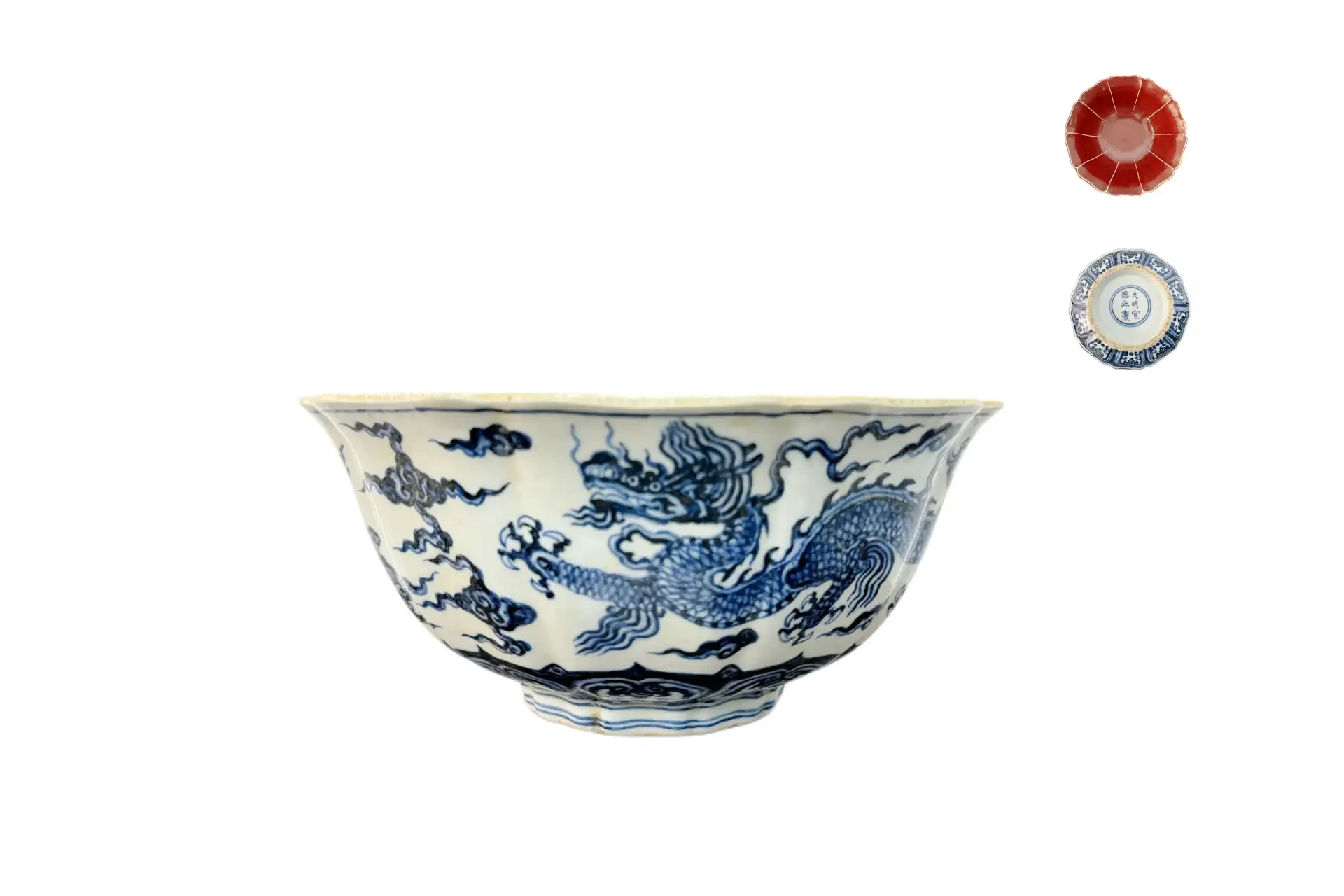
Ming Xuande Blue-and-White Bowl with Cloud and Dragon Motif in Underglaze Red
Size Specifications:C:22.5cm H:10cm BD:9.5cm
Category:porcelain
Request a Quote
Viewed36333times
Collection Appreciation
<p>This exquisite large bowl with a hibiscus-shaped rim, melon-segmented curved body, and well-defined ring foot bears the "Made in the Xuande Reign of the Great Ming" mark. It is a rare masterpiece combining blue-and-white porcelain on the exterior with copper-red glaze on the interior—a true dual achievement of Xuande imperial kiln craftsmanship. The bowl's form is dignified and full, with elegant lines. The interior is entirely covered in Xuande copper-red glaze, which displays a deep, vibrant red hue that is uniform, smooth, and lustrous. A delicate white edge appears along the petal ridges at the rim, creating the characteristic "lamp-wick mouth." Produced using copper as a coloring agent under high-temperature reduction firing, this red glaze was extremely difficult to control, resulting in very low success rates—hence its reputation as "one treasure in every thousand kilns." While Xuande red-glazed wares are already scarce, bowls featuring both blue-and-white exteriors and red-glazed interiors are exceptionally rare, representing the pinnacle of Ming dynasty imperial kiln production. The exterior is decorated with a dynamic dragon amidst swirling clouds, painted in cobalt blue. The dragon is depicted with powerful strength, clearly defined scales, flowing whiskers, and hair, surrounded by auspicious clouds. The cobalt pigment used is Sumali (Sapporo) blue, known for its rich, deep color and natural iron-rust crystalline spots—a hallmark of Xuande imperial ware. Near the foot, waves, mountains, and lotus-petal motifs are rendered with distinct layers and vigorous brushwork. The base bears the six-character楷书 inscription "Da Ming Xuan De Nian Zhi" within a double circle, written in steady, standard Xuande imperial script. This bowl unites the brilliance of gem-red glaze, the elegance of blue-and-white decoration, and the majesty of dragon imagery. Its dual-glaze technique, hibiscus-shaped rim, and single-color design make it a feat of exceptional technical difficulty; complete surviving examples are exceedingly rare.</p>