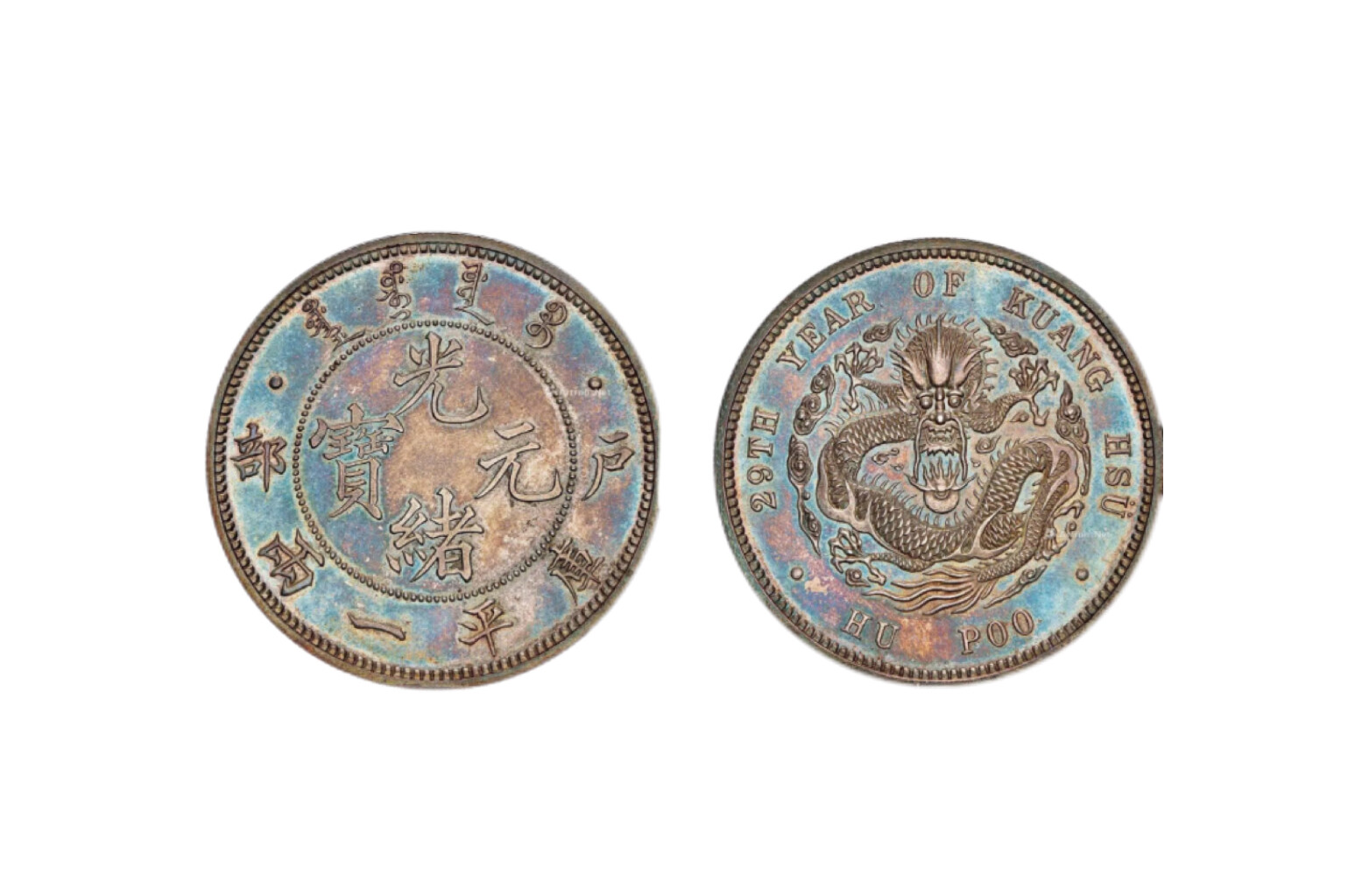
Guangxu Year 29, Ministry of Revenue Silver Yuan Coin Specimen (1 Liang Standard Weight)
Date of Creation:Qing Dynasty
Category:Currency
¥920,000
Sold1piece
Viewed125212times
Collection Appreciation
<p><span class="text-style" style="color: rgb(0, 0, 0); font-size: 14px; font-family: "Microsoft Yahei"; background-color: rgb(255, 255, 255);">A 1903 Huibu Silver Taël Pattern Coin, K-927/LM-1, "Ru" (入) variant. Struck from dies prepared by the Osaka Mint of Japan and trial-struck at the Peiyang Mint. Known in numismatic circles as the "Huibu One Taël," it is the largest-diameter machine-struck silver coin in China's modern minting history. At the time, due to the Qing government's unresolved debate between the taël and dollar systems, the coin was never officially issued. Only a few pattern coins survive today. Modern collectors group this piece with the Peiyang One Taël and Shanghai One Taël under the term "Three Taëls." Acquiring one elevates a collector to the highest tier. The die engraving is exquisitely detailed. Initial strikes show strong relief with high rims and sharp inner reeding. The fields are mirror-like, featuring bold, upright inscriptions and a majestic, dignified dragon design with full horns and finely defined scales. Over decades, oxidation has produced a stunning tonal patina in shades of purple, blue, gray, and red, reflecting vibrant rainbow hues that captivate the eye. This flawless state represents the ultimate prize for elite collectors and is exceedingly precious. PCGS SP63</span><br><span class="text-style" style="color: rgb(0, 0, 0); font-size: 14px; font-family: "Microsoft Yahei"; background-color: rgb(255, 255, 255);">In 1902 (1902), Viceroy of Zhili Yuan Shikai petitioned to establish a mint on the site of the Weiyu Camp at Xiyao Wa (the former location of Tianjin Dabeiyuan Temple), naming it the "Peiyang General Bureau of Minting Silver Dollars." Operations commenced formally on 15 12 later that year. Following Yuan Shikai's directives, the bureau began preparing production of the One Taël denomination and commissioned the Yokohama Bank of Japan to procure the dies. Through their inquiry, the work was assigned to the Osaka Mint. The Osaka Mint recommended increasing the One Taël's diameter by 10% compared to the standard 7 mace 2 candareens. This would prevent confusion between old and new currencies and make the larger, thicker planchets easier to distinguish during circulation. The Peiyang Mint adopted this suggestion, producing planchets approved by Yuan Shikai, and trial-struck approximately 6,000 to 7,000 finished coins. Unfortunately, due to the Qing court's continued indecision between the taël and dollar systems, the project was ultimately abandoned. The Huibu One Taël series includes five denominations: One Taël, Five Mace, Two Mace, One Mace, and Five Candareens. Based on surviving specimens, the vast majority of One Taël patterns were melted down for reminting, making extant examples extremely rare.</span><br><span class="text-style" style="color: rgb(0, 0, 0); font-size: 14px; font-family: "Microsoft Yahei"; background-color: rgb(255, 255, 255);">Numismatist Lin Xianzhang wrote in his book *Slow Color*: "It is difficult to find top-grade Huibu One Taël specimens. Along with the Peiyang One Taël and the Guangdong Seven-Three Mirror-Finish, the Huibu One Taël is considered a third-tier rarity in terms of quantity and status. However, while many pristine, original-color examples of the Guangdong Seven-Three exist due to excellent survival rates of the Soho Mint proofs, the Huibu One Taël inherited inherent craftsmanship flaws common to domestic pattern coins. While non-pristine examples exist, top-grade specimens are exceptionally rare—rarer even than those of the Peiyang One Taël struck at the same facility. Various human factors have nearly eliminated the existence of original-color, top-grade Huibu One Taëls. It is well known that the Huibu One Taël comes in two variants: 'Ren' (人) and 'Ru' (入)... Given their extreme scarcity and high prices, there is no need to obsess over distinguishing variants; acquiring a single specimen that meets your personal standards is sufficient."</span><br><span class="text-style" style="color: rgb(0, 0, 0); font-size: 14px; font-family: "Microsoft Yahei"; background-color: rgb(255, 255, 255);">During the 1970s and 1980s, only true masters of machine-strunk coin collecting could simultaneously own the rare trio of Huibu One Taël, Peiyang One Taël, and Shanghai One Taël. To this day, this standard remains valid. Assembling these three taël-denomination silver dollars requires not only substantial financial resources but also exceptional fortune.</span></p>